A streaming system may seem capable on paper but suffer when everything is operating at once. When the camera supports a high resolution, the game runs at a high frame rate, and the internet connection is fast enough for browsing, the broadcast can still become unstable. Live streaming is a series of connected processes. Your computer captures and encodes the video, your network uploads it continuously, and the streaming platform receives and processes it. If any part is a bottleneck, boosting quality settings can hurt the experience. The idea is not to max out every setting. Finding a balance between visual quality, motion, upload capacity, and hardware performance improves streaming. Understanding that principle makes stream settings less about guessing which preset looks spectacular and more about knowing your equipment and connection’s constraints.
Most Problems Start with Too Much Data
Every stream sends video data continuously. The quantity varies on resolution, frame rate, bitrate, encoder settings, and content. Fast gaming with constant movement and complex graphics is harder to encode and send than a simple talking-head stream. A connection that works fine for internet browsing may not work well for live broadcasting. Upload capacity is required for streaming, not only download speed. Dropped frames, buffering, poor quality, and interruptions might result from the stream’s outgoing data rate approaching the connection’s limit. The key is that the advertised internet speed is not necessarily the upload capacity you should use for streaming. Real-world performance may vary due to other devices and applications using the connection. Leaving headroom helps the stream stay stable during network disturbances.
Bitrate Connects Quality and Bandwidth
When balancing stream quality and internet connection, bitrate is crucial since it controls how much data the stream sends per second. As bitrate grows, encoders have more data to depict visual detail, but upload requirements increase. Reducing it simplifies transmission but increases compression and lowers image quality, especially in fast-moving scenes. Thus, your software’s maximum bitrate is not the useful one. It fits your resolution, frame rate, content, encoder, and platform while leaving network capacity for your other connections. Especially with gaming streaming. A static menu can look clean at a given bitrate, but rapid camera movement, grass, particles, crowds, or intricate textures can show compression. Creators should evaluate stream quality using broadcast material rather than static test images.
Upload Speed Matters More Than Download Speed for Live
Most speed tests in ordinary conversations focus on download speed, so many people rate their internet connection based on that. Upload capacity matters more for live streaming. Your computer sends the encoded stream outward; thus, the upstream connection must support it. A connection with decent download performance but unpredictable upload capability may struggle with broadcasting. When multiple devices share a connection, things get tricky. Uploading large files, making a video call, storing up images, or using another bandwidth-intensive program can restrict stream capacity. Network congestion might influence performance even if a speed test is good at another time. It is safer to allow for network activity and variations than to fill the maximum advertised upload speed. A consistent, low-bandwidth stream is usually better than a high-quality stream that drops data.
Resolution Should Match Content and Connection
Another place streamers can mistakenly stress their equipment is resolution. Moving from 720p to 1080p or higher resolution requires more picture processing and representation. When the video has enough bitrate and the viewer’s device can display the detail, increasing resolution can improve clarity, but it also raises workflow needs. To preserve image quality, a computer may need to process more pixels, the encoder may require more data to compress, and the network may need more bandwidth. This does not mean lesser resolution is always better. The stream type and system determine the best option. Higher resolution can improve a detailed gaming broadcast, while a webcam-focused stream may not. Resolution should be considered part of a whole configuration, not a quality upgrade.
Frame Rate Affects Motion Cost
Frame rate complicates the balancing act. Encoding and compression determine data requirements, although a 60-FPS video sends twice as many frames as a 30-FPS stream. Smoother motion is useful for quick games, sports, racing, and other rapidly changing content. The downside is that more frames require more processing and representation. As frame rate increases, hardware and bandwidth restrictions matter. In a slow presentation or conversation stream, 60 FPS may not provide any more benefit than 30 FPS. Fast gameplay can make the difference more visible. Choosing between them should depend on what the viewer needs to see, not the maximum frame rate. A reduced frame rate can free up resources for consistent encoding and image quality.
Your Encoder May Be the Hidden Bottleneck
Internet bandwidth is just one factor. Encoding collected video into a streamable format can strain the computer, depending on the encoder and its settings. Software encoders use the CPU; however, hardware encoders on suitable graphics hardware can offload some of that workload. Performance is affected by the hardware, the encoder implementation, the resolution, the frame rate, the preset, and the number of apps running at the same time. Even with a robust internet connection, a stream can have issues. Higher-quality settings may overtax a computer already rendering a game, recording video, running overlays, processing camera input, and encoding the broadcast. Viewing the entire workload is helpful. Streamers should focus on computing struggles throughout broadcasts, rather than expecting a CPU or graphics card to perform well in any game and streaming setting.
Game and Stream Performance Are Related
Gaming streams present an interesting issue because the same computer may produce the game and transmit. A challenging game might use a lot of graphics and computing power before streaming software starts. The encoder and capture process may have less room to operate while the game uses all resources. This scenario can cause the game to be playable but the stream unreliable, or the stream to work but the game to perform poorly. Limiting game frame rate or switching to demanding graphics settings can provide more headroom than lowering stream quality. The proper adjustment depends on whatever component is maxing out. If the broadcast stutters, high in-game settings are pointless. A streaming computer prioritizes consistency over game graphic settings irrespective of the broadcast.
Stable Connections Need Breathing Room
Treating bandwidth as a fixed number that can be used at full capacity continuously is a common mistake. Not all networks are predictable. Changes in household traffic, wifi interference, data transfers from other apps, and streaming service congestion can occur. A good stream setting should provide some room between the stream’s data needs and the connection’s upload capability. Wired Ethernet eliminates some wireless connection factors, making it valuable for reliability. Wi-Fi can stream; many creators do so. Every extra source of instability is important when a stream is at its limit. A perfect configuration may fail when another device uses the network. Headroom makes the configuration more adaptable to everyday adjustments.
Test Streaming Software Settings with Real Content
Not just because streaming software broadcasts correctly, but because a configuration should be appraised. A stream may work well in a peaceful area but fail in a busy scene. Thus, testing should incorporate broadcast content. Game creators should test quick mobility, busy surroundings, and their streaming games. The tutorial creator should test screen capture, webcam footage, transitions, and any presentation apps. Viewing the stream from the viewer side can expose issues the local preview missed. Testing is not about finding the highest settings for a minute. It is to find a reliable setup during a realistic session. After finding a steady baseline, individual variables can be increased cautiously rather than all at once, making it hard to pinpoint a problem.
Quality Loss Is Not Always the Best Solution
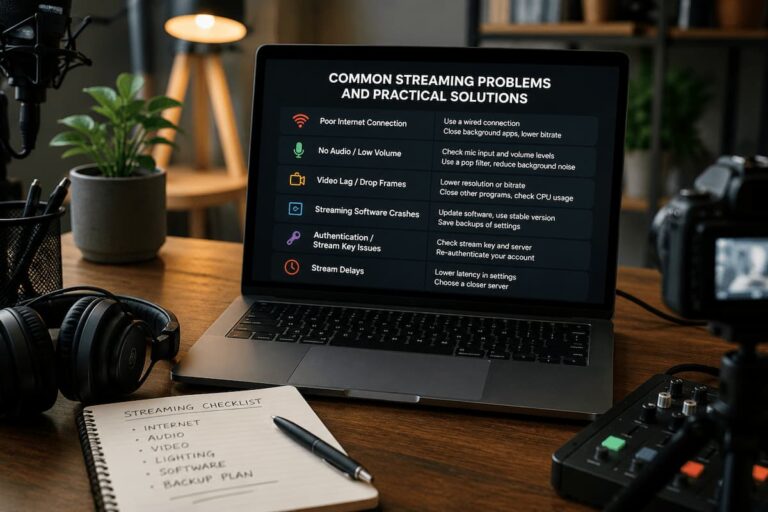
When a stream struggles, many creators lower resolution or bitrate. That sometimes resolves the issue, although identifying the problem is best. Changing network conditions or lowering the stream’s bitrate may assist in sustaining the upload rate. Lowering output resolution or frame rate may help if the encoder is overburdened. If the game is using almost all graphical resources, lowering in-game settings or frame rate may enhance broadcast quality without affecting stream quality. If wifi instability is the problem, switching to a cable connection may be better than altering video settings. Treatment of symptoms as clues is crucial. Lost frames from network issues indicate the connection, whereas encoding overload indicates the computer and encoder. Random quality adjustments can mask the problem without fixing it.
Viewer Experience Should Determine Quality
A technically stunning broadcast with buffering, stuttering, or frequent interruptions is not ideal. Live content cannot be downloaded before viewing, unlike pre-recorded videos. Quality includes stability. A sharp, continuous stream at a lesser resolution can be better than a struggling stream. Similar logic applies to frame rate. If gear or network cannot reliably maintain 60 FPS, smooth 30 FPS may be better. Thus, streamers should evaluate their setup based on the overall watching experience rather than particular specs. A broadcast feels professional when it has clear images, motion, reliability, audio synchronization, and uninterrupted delivery. Balanced configurations may look less spectacular in settings but perform better in practice.
When Lowering Resolution, Frame Rate, or Bitrate Makes Sense
When the setup exceeds system capabilities, lowering a stream setting is fine. A purposeful reduction can be one of the easiest methods to increase reliability. Bitrate directly influences upload needs; therefore, if the internet connection is restricting, check it. Reducing resolution or frame rate can help a computer process or encode. If the stream is largely talking, presenting, or camera video, a reduced frame rate may not affect viewer perception while clearing up resources. In fast-moving content, frame rate may be more important; hence, reducing resolution may be best. The decision should reflect the stream’s priorities. Because bandwidth, hardware, and visual quality vary by configuration, there is no common setting for creators.
Best Setup Allows for change
A streaming arrangement should be stable under normal conditions, not balanced near failure. Your workload may alter; thus, this factor is important. You can start streaming a simple game and progress to a harder one. New cameras may require more captures, or a family member may use the internet more. Streaming platforms can modify suggested settings and supported features. Setting up with flexibility makes modifications easy. To avoid reconstructing the setup after a software update or hardware change, document reliable settings. A quick test may not yield the system’s best baseline. This option works when the session lasts hours, the game is difficult, the network is busy, and the computer has other jobs running.
Conclusion
Balancing stream quality requires limit management. Resolution affects image information, frame rate affects movement smoothness, bitrate determines how much encoded data needs to be transmitted, internet connection determines data delivery consistency, and computer determines stream capture and encoding without overwhelming the system.
The smartest configuration doesn’t usually have every setting maxed out. A stable 1080p stream is better than an unstable higher-resolution broadcast, and a continuous 30 FPS stream is better than a hardware- or network-crashing 60 FPS stream. Finding the balance between image quality and system reliability is key.
Determine if your issue is bandwidth, encoding, game performance, or setup. Change one important setting at a time and test it with your streaming material. That method makes it easy to create a good-looking broadcast without straining your internet connection or hardware.
FAQs
1. How fast does the internet connection need to be for livestreaming?
There is no standard upload speed that applies to all livestreams, as the required speed depends on the bitrate and network activity. A livestream requires sufficient stable upload capacity to support the chosen bitrate, as well as sufficient bandwidth to handle normal network fluctuations and other connected devices.
2. Is a higher bitrate always better for livestreaming?
Not necessarily. Higher bitrates retain more image detail but also require more upload capacity. If the connection cannot stably support a higher bitrate, the livestream may become unstable. The correct bitrate must provide sufficient image quality without exceeding the actual capacity of the network.
3. Should I stream at 30 FPS or 60 FPS?
The answer depends on the content. Fast-paced games and action videos benefit significantly from 60 FPS, while discussion streams, tutorials, and other content with a slower pace may be sufficient with 30 FPS. Hardware and bandwidth limitations must also be considered.
4. Why is my livestream still stuttering, despite my fast internet connection?
The problem may not lie with your internet speed. Insufficient upload capacity, network instability, overload, wireless interference, encoder overload, or excessive computer load can all cause livestreaming issues. By determining whether the missed frames are due to network or encoder problems, you can better pinpoint the cause of the issue.
5. Should I lower the bitrate or resolution if my livestream is stuttering?
The answer depends on the cause. If it is a network problem, lowering the bitrate might help. In cases of computer or encoder overload, lowering the resolution or frame rate may be more effective. Before changing settings, check current performance data rather than relying on your gut feeling.
6. Is Wi-Fi sufficient for livestreaming?
Wi-Fi can support livestreaming, but stability depends on network conditions, signal quality, interference, router performance, and other network traffic. A wired Ethernet connection can eliminate a number of these variables, and if stability is crucial for livestreaming, a wired Ethernet connection might be a better choice.

Riley Bennett writes about content creation, streaming gear, and building efficient creator workflows at estergamer.com. After spending years testing equipment and figuring out what actually works versus what just looks impressive, Riley focuses on practical, no-nonsense advice for beginners starting from scratch. When not writing, Riley enjoys exploring new tech, refining home studio setups, and helping fellow creators skip the expensive mistakes that slow most people down. The goal is simple: honest guidance that gets real results without the marketing fluff.