Cooper has this habit. Every time I sit down to record, he wanders over, drops his tennis ball at my feet, and stares at me with those sad golden eyes that say, “You haven’t thrown this in fourteen minutes, which is basically abandonment.” He’s eight now, supposedly past his puppy energy phase, but the moment that microphone goes live, he remembers he absolutely must play fetch. Every. Single. Time.
I used to fight it. Paused recordings. Threw the ball. Came back. Forgot where I was. Started over. Lost my flow. Then I got smart. Now Cooper’s pre-record walk is non-negotiable. Twenty minutes around the block, ball in the backyard, he’s exhausted, I’m caffeinated, and we both know the deal. The workflow starts before the workflow starts.
That’s the thing nobody tells you about recording workflows. They don’t begin when you hit the red button. They begin hours earlier, in the choices you make about your environment, your energy, your mental state, and yes, your dog’s bladder. A smooth recording session is 80% preparation and 20% actual recording. The people who make it look effortless? They’ve already done the invisible work.
The Night Before: Setting Tomorrow Up for Success
I learned this from a musician friend who tours with a band I won’t name because you’ve heard of them. His pre-show ritual starts 24 hours before the show. Same meal. Same sleep schedule. Same vocal warmups. He treats consistency like a superstition because, in his words, “the audience doesn’t see the ritual, but they feel the result.”
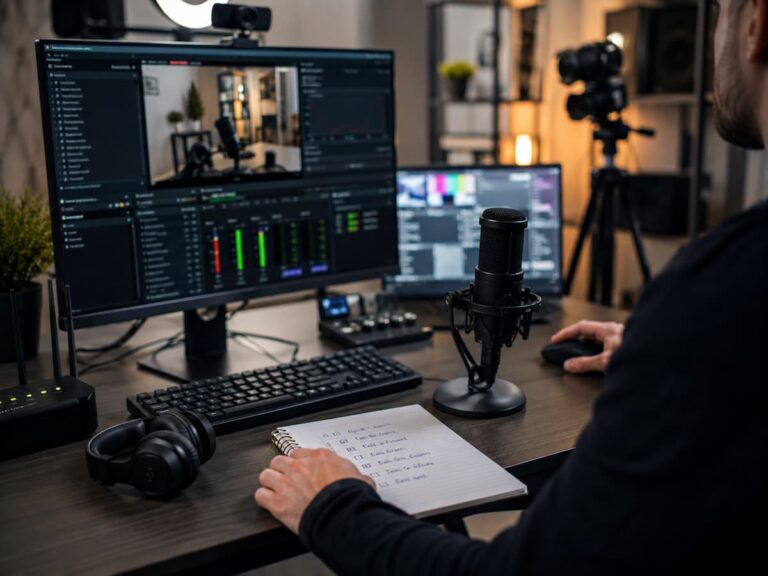
My recording ritual starts the evening before. I check my equipment then, not the morning of. Microphone cable seated properly? Check. SD cards formatted and empty? Check. Hard drive with 200GB free? Check. OBS scene collection loaded with the right sources? Check. If something’s broken, I have 12 hours to fix it instead of 12 minutes of panic.
I also write my outline or script the night before. Not the morning of. Morning-of writing is rushed and anxious and produces content that sounds like you’re reading a grocery list. Night-before writing lets ideas marinate. I sleep on it. Wake up with additions, subtractions, and better transitions. The subconscious does editing work while you dream. Don’t waste that free labor.
Finally, I set out my clothes. Sounds ridiculous. But decision fatigue is real. Every choice you make in the morning—what to wear, what to eat, what to record about—depletes the willpower you need for actual creative work. I lay out a comfortable shirt, prep my coffee maker, and set my outline on the desk. Morning me is grateful. Morning me has fewer excuses to procrastinate.
💡 What I Learned the Hard Way
I once showed up to record a sponsored video with a script I wrote that morning, a microphone I hadn’t tested in three weeks, and a memory card that was full of vacation photos from six months ago. The sponsor’s deadline was 48 hours. I spent the first four hours troubleshooting a ground loop I could have fixed the night before, another two hours writing a better script because the rushed one was garbage, and the final two hours actually recording. Eight hours of stress for two hours of content. Now my pre-record checklist is laminated and taped to my monitor. It takes 10 minutes the night before. It saves me from myself.
The Morning Ritual: Getting Your Brain Online
Not everyone records in the morning. I get that. But most people record when their brain is freshest, which for many is morning. The principle applies regardless of timing: you need a transition from “life mode” to “creator mode.” Not a switch. A ramp. Brains don’t switch instantly.
My ramp looks like this: Wake up. No phone for 30 minutes. The phone is a dopamine slot machine that scatters your attention before you’ve even decided what to focus on. Coffee. Shower. The shower is where I mentally rehearse the opening of my recording. I say it out loud. If it sounds stupid in the shower, it will sound stupid on camera. Better to find out privately.
Then I walk Cooper. This isn’t optional exercise. It’s a thinking walk. No podcast. No music. Just me, the dog, and the script bouncing around my head. I often come back with three better opening lines than the one I wrote last night. Movement activates creative thinking. Sitting at a desk does not.
Back home. Final equipment check. Everything from last night’s prep is still good. I hope. One time it wasn’t my cat Moochi had knocked a cable loose overnight. She’s twelve, arthritic, and somehow still manages to find the one wire that matters. I check everything again. Five minutes. Peace of mind.
The Physical Space: Consistency Through Environment
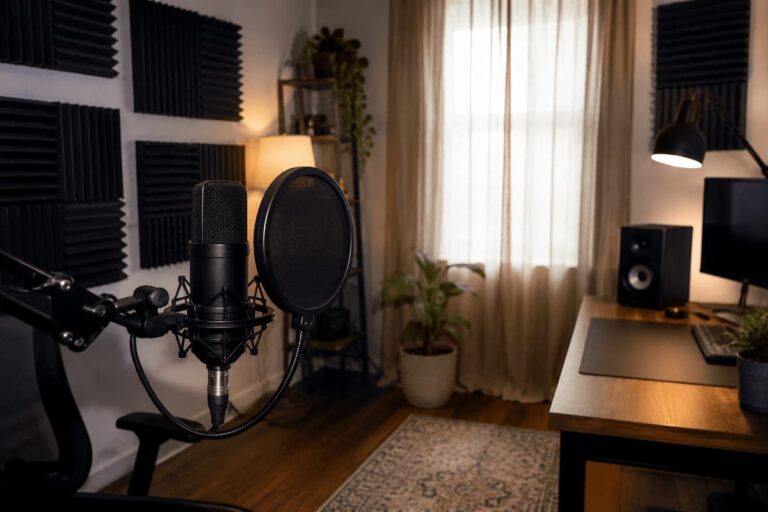
Your recording space should be a trigger. When you enter it, your brain should shift into “work mode” automatically. This only happens if the space is used exclusively for recording. If you record at the same desk where you pay bills, answer emails, and scroll Reddit, your brain stays in “miscellaneous life mode.” The context is confused.
I rearranged my office specifically for this. The recording corner is visually distinct. Different lamp. Different chair angle. A small plant I only see when I’m facing the camera. These cues tell my brain: we’re doing this now.” Not that. This.
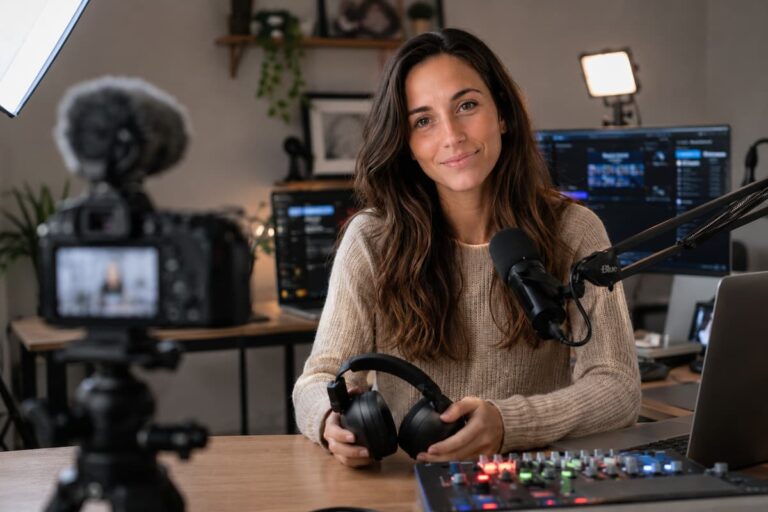
The physical setup itself is standardized. I have a diagram on my phone showing exactly where the microphone sits relative to my mouth, where the light stands go, and where the camera angle hits. I don’t eyeball it. I measure. Because “close enough” creates subtle differences in audio and video that your audience notices even if they can’t name them. Consistency is invisible professionalism.
| Element | My Fixed Position | Why It Matters |
| Microphone | 6 inches from mouth, slightly off-axis left | Consistent proximity effect and plosive avoidance. Same tone every session. |
| Key light | 45 degrees right, 2 feet above eye level | Same shadow pattern on face. Same catchlight in eyes. Visual continuity across videos. |
| Camera | Eye level, 3 feet away, 24mm equivalent | Natural perspective without distortion. Same framing every time. No “why does my nose look bigger today?” surprises. |
| Background | Bookshelf left, blank wall right, plant center | Visual interest without distraction. Same environment = same brand identity. |
I measured these positions once and wrote them down and now reset to them before every session. It takes 90 seconds. The time I save not adjusting framing and audio levels mid-record pays for itself in the first take.
⚠️ The “I’ll Fix It in Post” Lie
I used to be lazy about setup. “The audio is a little off, but I’ll fix it in editing.” “The lighting is uneven, but color correction will handle it.” This is a trap. Every “fix in post” adds 10 minutes to your editing time. Ten fixes? Two hours of extra work. Two hours you could spend recording more content, or walking your dog, or literally anything else. The workflow that saves time is the one that prevents problems, not the one that solves them after the fact. Get it right before you hit record. Your future self is begging you.
The Recording Phase: Flow State Protection
Once I hit record, I enter a protected zone. My phone goes in another room. Not on silent. Not face-down. Another room. The door closes. Cooper is sleeping off his walk in the living room. Moochi is… somewhere. Probably plotting. The point is, interruptions are eliminated before they can happen.
I record in chunks. Not full scripts. Full scripts lead to perfectionism, which leads to restarting the same sentence seventeen times. I record a section, pause, review mentally, and move on. If I stumble, I pause, take a breath, and restart from the last natural break point. I don’t stop the recording. I keep rolling. The edit handles the splice.
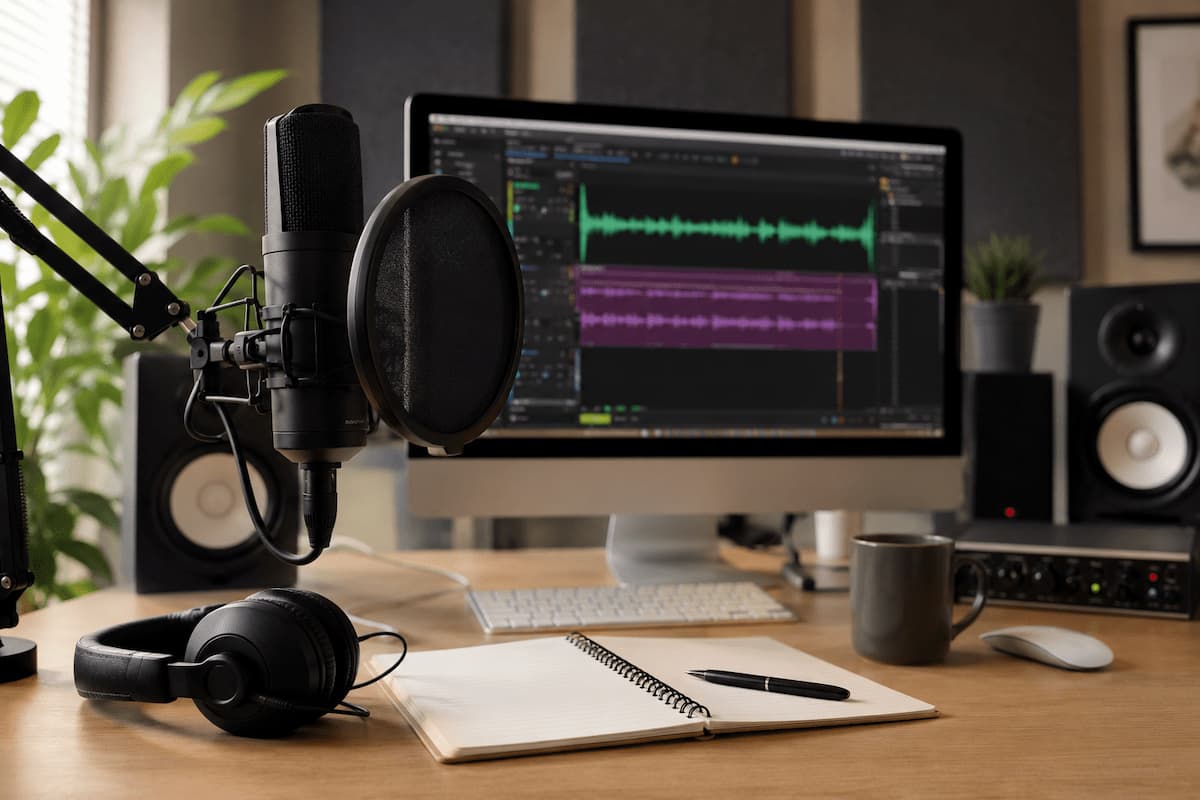
This technique—recording long takes with internal restarts—requires one critical habit: verbal markers. When I mess up, I say “CUT” out loud, pause two seconds, then restart. In editing, the “CUT” creates a visible spike in the waveform. I can see exactly where to splice. No hunting for the error. No listening to the whole take to find the stumble. The marker is the map.
I also hydrate continuously. Dry mouth sounds terrible on a microphone. I keep a water bottle with a straw (quieter than unscrewing a cap) just out of frame. Sip between sentences. Not during. The straw prevents the glug-glug sound that water bottles make.
The Energy Management Nobody Talks About
Recording is physically exhausting in a way that surprised me. You’re performing. You’re projecting energy. You’re maintaining posture. You’re thinking three sentences ahead while speaking the current one. It’s like public speaking to an empty room, which is somehow more draining than public speaking to a full room.
I learned my limits the hard way. My first long recording session was three hours. I was proud. Then I listened back. The first 30 minutes were energetic and engaging. The next 60 were competent. The final 90 were monotone zombies reading words off a screen. I had to re-record the entire second half. Six hours total for three hours of usable content.
Now I work in 45-minute blocks. Record for 45. Break for 15. Walk around. Stretch. Let Cooper out. Check my phone (guiltily). Then back for another 45. Two blocks are my daily max. That’s 90 minutes of recording, which usually yields 60-75 minutes of final content after editing. More than enough for a week’s publishing schedule.
The break isn’t procrastination. It’s recovery. Your vocal cords need rest. Your brain needs context switching. Your body needs movement. Sitting in a chair performing for three hours straight is a recipe for garbage content and a sore back.
✅ The Energy Audit You Should Run
Record yourself for 90 minutes straight. Don’t stop. Don’t edit. Then listen back in 15-minute chunks. Note the timestamp where your energy drops. Where your voice flattens. Where you start rushing sentences to get them over with. That’s your real limit. Not your willpower limit. Your physical limit. Respect it. Structure your workflow around it. I discovered my drop happens at minute 52. Now I never record past 45 minutes without a break. My content quality improved immediately. My re-record rate dropped by 70%. The break isn’t lost time. It’s insurance against lost quality.
The Shutdown Ritual: Closing the Loop
What happens after recording matters as much as what happens during. An open loop—files unbacked up, equipment left out, notes unreviewed—creates mental clutter that bleeds into tomorrow. You wake up thinking about the mess you left. That cognitive load reduces your creative capacity before you even start.
My shutdown ritual is rigid. I love it. It means I’m done. The work is contained. I can relax without guilt.
First: backup. Files copy to two locations before I leave the desk. External SSD and cloud storage. Redundancy isn’t paranoia when you’ve lost a day’s work to a hard drive failure. I name files with the date and content descriptor immediately. “2026-06-14-podcast-intro-raw. wav” not “Audio_001. wav.” Future me searches by date and topic. Future me is grateful.
Second: equipment reset. Microphone back in its case. Lights unplugged. Camera capped. Chair returned to its normal position. The space transforms from “studio” back to “room.” This physical reset signals mental closure. Work is over. Life resumes.
Third: notes. I write three sentences about what worked and what didn’t. “Opening was strong. Middle section rambled—tighten the outline next time. Energy dropped at 40 minutes; consider splitting into two topics.” These notes compound. After twenty sessions, I have a personalized guide to my own workflow weaknesses. No book or course can give you that. Only your own observation.
Fourth: the reward. This sounds silly but it’s crucial. I make a cup of tea. I sit on the porch with Cooper. I do something that feels like a transition from “work” to “rest.” The reward reinforces the ritual. The brain learns: complete the shutdown and get the good thing. It becomes self-sustaining.
Building Your Own Workflow From These Pieces
None of this is prescriptive. My workflow works because it fits my life, my energy patterns, my dog’s schedule, and my cat’s sabotage tendencies. Your workflow will be different. Maybe you record at night. Maybe you don’t have pets but you have kids who need homework help. Maybe your best energy is mid-afternoon, not morning.
The principles are transferable even if the specifics aren’t:
- Prepare before you need to prepare. The night before is your friend.
- Create environmental triggers that shift your brain into creator mode.
- Standardize your physical setup so it’s automatic, not decision-based.
- Protect your recording time like it’s a meeting with your most important client (it is).
- Work within your actual energy limits, not your aspirational ones.
- Close every loop before you leave. Backup, reset, reflect, reward.
I used to think workflow was about efficiency. Doing more in less time. Now I think it’s about sustainability. Doing good work consistently, without burning out, without dreading the process. The smooth workflow isn’t the one that squeezes every ounce of productivity from your day. It’s the one that makes you want to show up again tomorrow.
Cooper is asleep now, snoring softly in the corner. Moochi is staring at me from the windowsill, judging my life choices. The equipment is put away. The files are backed up. The notes are written. Tomorrow’s outline is half-formed in my head, ready to be captured tonight before bed. The loop is closed. The ritual worked.
Tomorrow, we’ll do it again. And because the workflow is smooth, I’ll actually look forward to it.
🎯 The One Question That Fixes Everything
When your workflow feels broken, when recording is a chore, when you’re avoiding the desk, ask yourself this: “What is the smallest friction point I could eliminate today?” Not the biggest problem. The smallest. The thing that takes 30 seconds but annoys you every single time. For me, it was untangling my microphone cable, which was always a knot because I threw it in a drawer. I bought a cable hook for $4. Mounted it under the desk. Problem solved forever. One tiny friction point eliminated. Compound ten of those and your workflow becomes effortless. Don’t overhaul everything. Fix one small thing. Then another. Momentum builds from the bottom up.

Riley Bennett writes about content creation, streaming gear, and building efficient creator workflows at estergamer.com. After spending years testing equipment and figuring out what actually works versus what just looks impressive, Riley focuses on practical, no-nonsense advice for beginners starting from scratch. When not writing, Riley enjoys exploring new tech, refining home studio setups, and helping fellow creators skip the expensive mistakes that slow most people down. The goal is simple: honest guidance that gets real results without the marketing fluff.