The Wake-Up Call: Why One Income Stream Is a Dangerous Gamble
Let me tell you about Marcus. Marcus had a thriving YouTube channel with 200,000 subscribers. He made $8,000 a month from AdSense alone and thought he had it made. Then January 2023 happened. YouTube changed its algorithm, his views dropped 60% overnight, and his income cratered to $2,400. He had no backup plan, no savings buffer, and a mortgage to pay.
That’s the reality most creators face. We put all our eggs in one basket—usually AdSense, brand deals, or affiliate links—and pray the algorithm gods stay kind. But here’s the truth: platforms change, algorithms shift, and brand budgets dry up. The creators who survive and thrive are the ones who treat their content like a business with multiple revenue pillars.
When I started diversifying, I didn’t have a business degree or a trust fund. I had a laptop, a willingness to experiment, and the humility to start small. My first additional income stream was selling $5 digital templates on Etsy. I made $23 in my first month. It felt pathetic. But that $23 taught me something critical: I could create something once and sell it repeatedly. That mindset shift changed everything.
Understanding the Content Creator Income Landscape
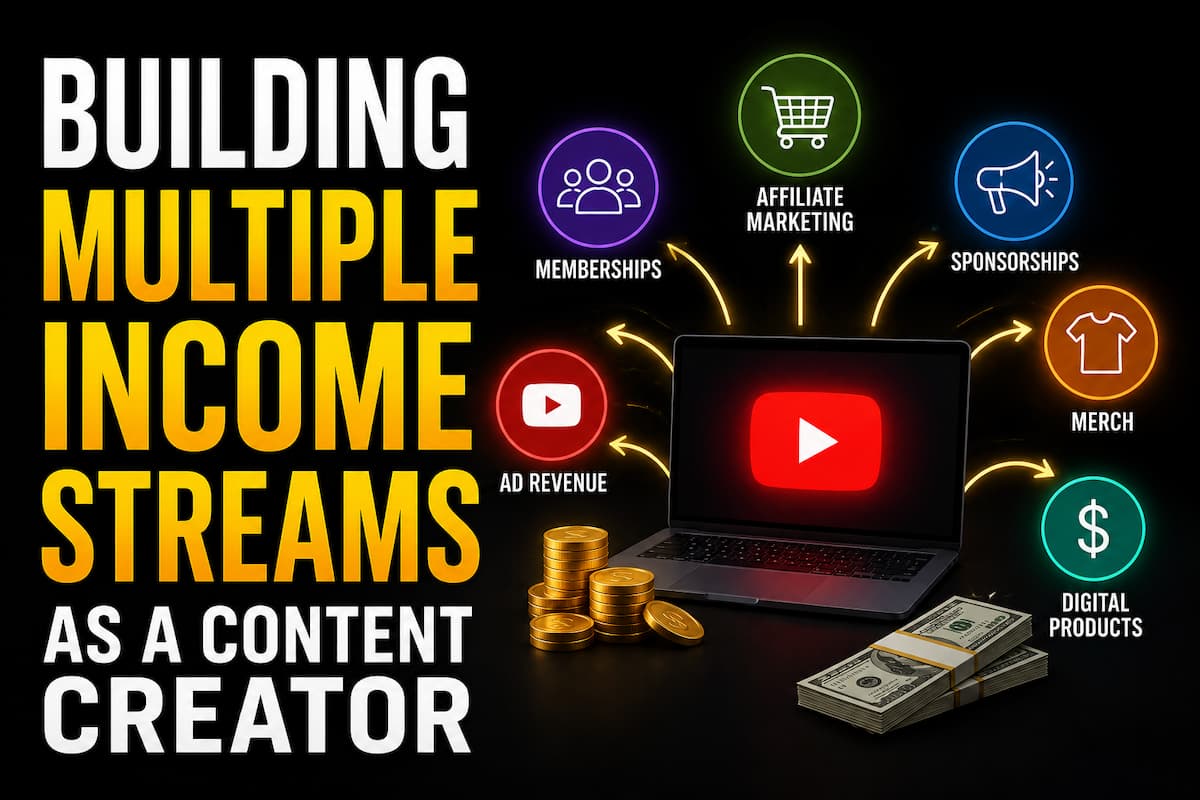
Before you start building, you need to know what you’re building with. Here’s a breakdown of the major income streams available to content creators, ranked by accessibility and scalability:
| Income Stream | Startup Cost | Time to First Dollar | Scalability | Best For |
|---|---|---|---|---|
| Ad Revenue (YouTube, Blog) | Free | 3-12 months | High (passive) | High-traffic creators |
| Brand Sponsorships | Free | 1-6 months | Medium | Niche influencers |
| Affiliate Marketing | Free | 1-3 months | High (passive) | Review/tutorial creators |
| Digital Products | $0-$100 | 1-2 months | Very High | All creators |
| Online Courses | $50-$500 | 2-6 months | Very High | Expertise-based creators |
| Memberships/Subscriptions | $0-$50/month | 1-3 months | High | Community builders |
| Freelance Services | Free | Days to weeks | Low (trading time) | Skilled creators |
| Physical Products/Merch | $100-$1,000 | 1-3 months | Medium | Strong brand identity |
The key insight here isn’t to chase the “highest-paying” option. It’s to stack complementary streams that fit your skills, audience, and available time. A YouTuber who does tech reviews might crush affiliate marketing while a fitness creator might thrive with digital workout plans. There’s no one-size-fits-all.
Stream #1: Affiliate Marketing — The Gateway Drug of Creator Income
Affiliate marketing was my first real breakthrough, and I think it should be every creator’s starting point. Here’s why: you don’t need to create a product, handle customer service, or invest money upfront. You simply recommend products you already use and earn a commission when someone buys through your link.
My first affiliate success came from an unexpected place. I made a YouTube video about my desk setup—just a casual tour of my home office. I included Amazon affiliate links to my monitor arm, keyboard, and desk lamp in the description. That video got 8,000 views in its first month and generated $340 in commissions. I was shocked. People actually wanted to buy the stuff I was using.
How to Do Affiliate Marketing Right (Without Being Sleazy)
- Only promote products you genuinely use and trust. Your audience can smell a fake recommendation from a mile away. I once promoted a microphone I hadn’t tested, got three refund requests from angry buyers, and lost credibility I spent months building.
- Disclose your affiliate relationships transparently. Not just because the FTC requires it, but because trust is your most valuable asset. I put a simple note at the top of every description: “Some links below are affiliate links—I earn a small commission at no extra cost to you.”
- Create content that solves problems, not just sells products. My highest-earning affiliate content is a blog post titled “How I Organized 500+ Files in Notion” where I casually mention my favorite templates. It gets 2,000 monthly views and earns $200/month passively because it actually helps people.
- Track what works and double down. I use a simple spreadsheet to monitor which links generate clicks and conversions. After six months, I noticed 70% of my affiliate income came from just three products. So I created more content around those specific items.
Stream #2: Digital Products — Create Once, Sell Forever
This is where things get exciting. Digital products—templates, guides, presets, spreadsheets, and ebooks—are the closest thing to passive income I’ve found as a creator. I spent three weekends creating a set of 20 Instagram story templates in Canva. I listed them on Gumroad for $12. In the first year, they generated $4,200 in sales. I haven’t touched them since.
But here’s what nobody tells you: the first digital product you create will probably flop. Mine did. I spent two weeks writing a 40-page ebook about social media strategy. I sold 11 copies in three months. Total revenue: $77. I was devastated. But instead of giving up, I analyzed what went wrong.
The problem wasn’t the content—it was the format and pricing. My audience wanted quick, actionable solutions, not a 40-page manifesto. They wanted something they could use in 10 minutes, not something they had to read for an hour. So I pivoted. I took the best parts of that ebook and turned them into a 5-page checklist with 50 actionable tips. I priced it at $7. It sold 300 copies in the first month.
Digital Products That Work for Different Creator Types
| Creator Type | Digital Product Ideas | Platform to Sell |
|---|---|---|
| Photographers/Videographers | Lightroom presets, LUTs, shot lists, client contract templates | Gumroad, Etsy, and your own website |
| Writers/Bloggers | Ebooks, writing templates, content calendars, pitch templates | Amazon KDP, Gumroad, ConvertKit |
| Designers | Canva templates, UI kits, font bundles, brand guidelines | Creative Market, Etsy, Gumroad |
| Fitness/Health | Workout plans, meal prep guides, habit trackers, meditation scripts | Gumroad, Patreon, own website |
| Business/Finance | Budget spreadsheets, business plan templates, invoice templates | Etsy, Gumroad, and your own website |
| Educators/Tutors | Study guides, flashcard sets, lesson plan templates, practice tests | Teachers Pay Teachers, Gumroad |
The beauty of digital products is that they compound. Each product you add creates another income stream that runs in the background. I now have 12 digital products across three platforms. Some months, one product takes off because of a viral post or seasonal trend. Last December, my “Year-End Content Audit Spreadsheet” made $800 in two weeks because creators were planning their January strategy. I created it in July and forgot about it.
Stream #3: Online Courses — Turning Expertise Into Real Revenue
Courses are the heavy hitter of creator income. They require more upfront work but can generate substantial, recurring revenue. My first course was a 3-hour video series on “Building a Content Calendar That Actually Works.” I priced it at $97 and launched it to my email list of 800 people.
I sold 23 copies in the first week. That’s $2,231 from a list of 800 people. The math blew my mind. If I had tried to make that same amount through AdSense, I would have needed roughly 1.1 million views (at a $2 CPM). Instead, I sent five emails and recorded some videos.
But courses aren’t just about recording videos and throwing them online. The successful course creators I know follow a specific pattern:
The Course Creation Framework That Actually Works
- Validate before you build. I don’t create a single lesson until I’ve pre-sold at least 10 copies. I write a detailed outline, create a sales page, and offer early-bird pricing. If people don’t buy the outline, they won’t buy the finished course. This saved me from building two courses that nobody wanted.
- Price based on transformation, not length. My most profitable course is 2 hours long and costs $197. My least profitable was 8 hours and cost $47. People pay for outcomes, not content volume. The $197 course teaches people how to land their first brand deal. The $47 course was a comprehensive “everything about content creation” overview that overwhelmed buyers.
- Build community around the course. Solo courses have high refund rates. Courses with a community component (even a simple Discord server or Facebook group) have dramatically better completion and satisfaction rates. I added a private community to my $197 course and saw refunds drop from 12% to 3%.
- Update and relaunch annually. Platforms change. Strategies evolve. I update my courses every 12 months and do a “2.0 relaunch” with new bonuses. This creates a fresh revenue spike and keeps existing students happy.
Stream #4: Memberships and Subscriptions — The Stability Layer
If affiliate marketing is the gateway and courses are the heavy hitter, memberships are the foundation. They’re the most predictable income stream you can build. I launched a Patreon in January 2022 with three tiers: $5, $15, and $35 per month. I started with 12 patrons. Today, I have 340 patrons generating $3,400 in monthly recurring revenue.
That’s $3,400 I can count on every single month, regardless of algorithm changes, brand deal droughts, or seasonal slumps. It’s not “passive” in the true sense—I create exclusive content, host monthly Q&As, and engage in the community—but it’s stable income that lets me sleep at night.
What Makes a Membership Worth Paying For?
I spent six months studying successful creator memberships before launching mine. Here’s what I learned:
- Exclusivity beats volume. My patrons don’t want more content—they want access to me and to each other. The $35 tier includes a monthly 30-minute group call where I review their content strategies. That’s the tier with the lowest churn rate because the value is personal and irreplaceable.
- Consistency matters more than perfection. I post one exclusive piece of content per week. It might be a 5-minute voice memo, a template, or a quick tutorial. But I never miss a week. That reliability builds trust. My patrons know that if they pay, they get value. Period.
- Community is the real product. The most engaged patrons aren’t there for my content—they’re there for the other members. I intentionally foster connections between patrons. When someone asks a question, I often tag another member who faced the same challenge. The community becomes self-sustaining.
Other platforms to consider: Substack for writers (newsletter subscriptions), Ko-fi for casual support with bonus content, and Circle for premium community building. I use Patreon for my general audience and a private Circle community for my course alumni. Each serves a different purpose and audience segment.
Stream #5: Freelance Services and Consulting — Trading Time for High Value
This is the most “active” income stream, but it’s also the fastest way to generate significant cash when you need it. I offer two services: content strategy consulting ($200/hour) and done-for-you content calendars ($1,500 per project). I limit this to 5 hours per week because I value my time, but those 5 hours generate $3,000-$5,000 in additional monthly income.
The key to successful freelance work as a creator is leveraging your existing audience and expertise. I don’t cold pitch. People reach out because they’ve seen my content, trust my approach, and want personalized help. My consulting clients are often creators who’ve been following me for months and finally decide they need hands-on guidance.
How to Position Your Services Without Undercutting Yourself
- Package outcomes, not hours. Nobody wants to buy “2 hours of consulting.” They want to buy “a content strategy that generates your first 1,000 email subscribers.” I price based on the transformation, not my time. A $1,500 content calendar project takes me 6 hours. That’s $250/hour. But I never quote hourly rates—I quote project outcomes.
- Use your content as a portfolio. Every blog post, video, and social media post is proof of your expertise. When a potential client asks for samples, I send them three pieces of content that demonstrate the exact skills they’re hiring for. My content does the selling for me.
- Set boundaries from day one. I learned this the hard way. Early in my consulting work, I gave clients my personal phone number and answered messages at 10 PM. Within three months, I was burned out and resentful. Now I have clear boundaries: all communication goes through email, I respond within 24 business hours, and I don’t take on rush projects. Clients who respect those boundaries are the ones I want to work with anyway.
Putting It All Together: My Current Income Stack
Here’s what my actual revenue breakdown looks like in a typical month. This isn’t hypothetical—it’s from last quarter’s numbers:
| Income Stream | Monthly Average | % of Total | Time Required (hrs/week) |
|---|---|---|---|
| Digital Products (Gumroad + Etsy) | $1,800 | 22% | 2 (maintenance) |
| Online Courses | $2,500 | 31% | 3 (community + updates) |
| Patreon Membership | $3,400 | 42% | 5 (content + community) |
| Affiliate Marketing | $800 | 10% | 1 (tracking + optimization) |
| Consulting/Freelance | $3,000 | 37% | 5 (active work) |
| Brand Sponsorships | $1,500 | 18% | 3 (negotiation + content) |
| Total Monthly | $13,000 | — | 19 hours/week |
Notice something important: the percentages add up to more than 100% because income streams fluctuate. Some months, consulting is $5,000. Other months, it’s $1,500 because I turn down projects to focus on course updates. The point isn’t the exact numbers—it’s the diversification and flexibility. If one stream dips, others compensate. If I want to take a vacation, my digital products and memberships keep earning while I’m offline.
The Step-by-Step Roadmap: Where to Start Based on Your Situation
I’ve talked to enough creators to know that “just do everything” isn’t helpful advice. Here’s a practical roadmap based on where you are right now:
If You’re Just Starting (0-5,000 followers)
- Month 1-2: Set up affiliate links for products you already use. Focus on Amazon Associates and any software/tools you recommend.
- Month 3-4: Create your first digital product. Start small—a $5-$15 template, checklist, or guide. Use Gumroad (free to start).
- Month 5-6: Launch a simple membership or subscription. Even a $3/month tier on Ko-fi or Patreon builds the habit of recurring revenue.
If You Have Momentum (5,000-50,000 followers)
- Priority 1: Build an email list. This is non-negotiable. Social platforms can disappear; your email list is yours. Use ConvertKit or Mailchimp. Offer a free digital product as a lead magnet.
- Priority 2: Develop a signature course. Survey your audience about their biggest challenge. Create a course that solves it. Pre-sell before you build.
- Priority 3: Systematize your affiliate strategy. Create dedicated content (blog posts, videos, and resource pages) that drives consistent affiliate income.
If You’re Established (50,000+ followers)
- Scale your highest-performing stream. If courses are working, create a second, more advanced course. If memberships are thriving, add a premium tier with personal access.
- Build a team. You can’t do everything yourself. I hired a virtual assistant for 10 hours/week to handle customer service and community management. It freed me up to create more high-value content.
- Explore licensing and partnerships. At this stage, your content and brand have value beyond direct sales. I’ve licensed my templates to productivity apps and co-created products with tool companies I use.
Common Mistakes That Slow Down Your Progress
I’ve made every mistake on this list. Learn from my failures so you don’t have to repeat them:
- Trying to launch five streams at once. I did this in month four. I was running affiliate links, selling templates, trying to build a course, and pitching brand deals simultaneously. I burned out and did all of them poorly. Master one stream before adding the next. I recommend a 3-month minimum focus period per stream.
- Underpricing out of fear. My first course was $27 because I was scared nobody would pay more. I sold 40 copies and made $1,080. When I raised the price to $97 and improved the content, I sold 35 copies and made $3,395. Price is a signal of value. Underpricing signals low quality.
- Ignoring the email list. For my first year, I relied entirely on social media to drive sales. Then Instagram shadow-banned my account for two weeks. My income dropped 70%. I immediately started building an email list. Today, 40% of my product sales come from email, and that number grows every month.
- Creating products nobody asked for. That 40-page ebook I mentioned? I never asked my audience if they wanted it. I assumed. Assumption is expensive. Now I survey my audience before creating anything over $50. I ask, “What’s your biggest challenge right now?” and “Would you pay for a solution?” The answers guide everything I build.
- Neglecting customer service. Digital products aren’t “set it and forget it.” People have questions, technical issues, and refund requests. I ignored this for months and got negative reviews that hurt my sales. Now I respond to every inquiry within 24 hours. My Gumroad store has a 4.9-star average, and those reviews drive new sales.
Conclusion:
Building multiple income streams as a content creator isn’t about becoming a millionaire overnight. It’s about creating stability, freedom, and the ability to keep creating without financial stress. Three years ago, I was staring at a $47 PayPal notification wondering if this whole creator thing was sustainable. Today, I have a diversified business that supports my life and lets me do work I genuinely care about.
But here’s the most important thing I’ve learned: the best time to start your second income stream was yesterday. The second-best time is today. You don’t need a perfect plan. You don’t need a massive audience. You need one product, one affiliate link, or one service offering that solves a real problem for real people.
Start with what you have. Use the tools already available. Create something small and imperfect. Learn from the feedback. Iterate. Add another stream. Repeat. That’s the entire playbook. There’s no secret formula, no magic platform, no shortcut. Just consistent, intentional work that compounds over time. Your content has value. Your expertise has value. Your audience is waiting for you to offer them solutions. Stop overthinking and start building. Your future self—the one who doesn’t panic when the algorithm changes—will thank you.

Riley Bennett writes about content creation, streaming gear, and building efficient creator workflows at estergamer.com. After spending years testing equipment and figuring out what actually works versus what just looks impressive, Riley focuses on practical, no-nonsense advice for beginners starting from scratch. When not writing, Riley enjoys exploring new tech, refining home studio setups, and helping fellow creators skip the expensive mistakes that slow most people down. The goal is simple: honest guidance that gets real results without the marketing fluff.